Boost I/O Strategy - The Internals of Libuvc
Published:
by
Zhenghui Lee

- Categories:
- io-strategy 3
This article is Part 3 in a 3-Part Series.
- Part 1 - Boost I/O Strategy In Web Server - Motivation
- Part 2 - Boost I/O Strategy - Dive into Libev and Libeio
- Part 3 - This Article
Table of Contents
- Table of Contents
- Background: The "Vibe Coding" Experiment
- Feature Highlights
- Architecture: Modularization & Flexibility
- Coroutines: Sync-over-Async
- Cross-Platform Development: The Mocking Story
- Performance Analysis
- Conclusion
It has been a long time since my last post in this series. In the previous articles, we explored the depths of libev and libeio. Today, we are not just analyzing the famous libuv (the spiritual successor to the libev+libeio combo), but exploring a derivative project born from a "Vibe Coding" experiment: Libuvc.
Background: The "Vibe Coding" Experiment
libuv is the powerhouse behind Node.js, providing a cross-platform asynchronous I/O abstraction. While libev and libeio laid the groundwork, libuv unified them into a robust production-grade library.
However, libuv's maturity means strict API/ABI stability, making it hard to experiment with radical architectural changes like pluggable coroutines or mixing modern Linux features like io_uring into the core loop.
Libuvc is a learning project created in a 2-day immersive "Vibe Coding" session (AI-assisted pair programming). The goal was to verify if AI agents could assist in complex system-level programming tasks—specifically, refactoring a 50k+ LOC C codebase into a modular, coroutine-native runtime.
The result is libuvc: a stripped-down, highly modular version of libuv that serves as a playground for advanced I/O strategies.
Feature Highlights
Libuvc focuses on two transformative features that distinguish it from the classic libuv:
- Modular & Pluggable Design (SPI-driven): Unlike the monolithic nature of traditional event libraries, Libuvc abstracts IO backends and File System engines into Service Provider Interfaces (SPIs). This allows for swapping or fallback between implementations (e.g.,
epoll,io_uring,kqueue) without modifying the core loop logic. - Sync-over-Async Style API: By leveraging lightweight coroutines, the library transforms complex asynchronous callback chains into a natural, linear programming flow. Developers get the high-concurrency benefits of non-blocking I/O with the code readability of synchronous logic, with the request context implicitly managed on the coroutine stack.
Architecture: Modularization & Flexibility
The core philosophy of libuvc is pluggability. Unlike standard libuv where backends are largely determined at compile-time by the OS, libuvc introduces strict SPIs (Service Provider Interfaces) for key components.
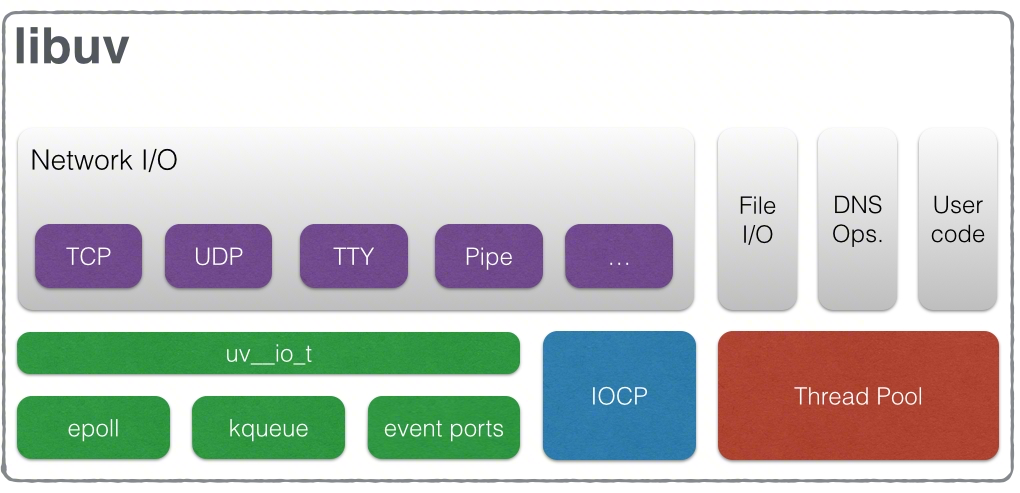
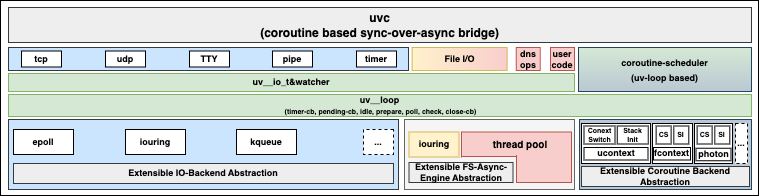
Visual Comparison: From Monolithic to Modular
Below are the architecture diagrams illustrating the shift from the traditional libuv structure to the modular libuvc design.
Before: Traditional Libuv Architecture
After: Libuvc (Modular & Coroutine-native)
1. The Matrix of Backends
We decoupled the event loop and the file system engine from their specific implementations. While the IO Backend is explicitly selected (or auto-detected) during loop initialization without runtime fallback, the Async-FS Engine is designed with a fallback mechanism (e.g., automatically falling back to threadpool if io_uring is unavailable or fails).
| Platform | Loop Backend | Async-FS Engine | Coroutine Provider |
|---|---|---|---|
| Linux | epoll, iouring |
threadpool, iouring (w/ fallback) |
ucontext, fcontext, photon |
| macOS | kqueue |
threadpool |
ucontext, fcontext, photon |
This design allows for interesting combinations. For example, on Linux, you can run:
- Legacy Mode:
epoll(Network) +threadpool(File I/O). - Modern Mode:
epoll(Network) +iouring(File I/O). - Bleeding Edge:
iouring(Network + File I/O).
2. "One Loop, One Wait Point"
A critical design principle in libuvc is preserving the "One Loop" property. Even when mixing epoll for networking and io_uring for file system operations, we ensure there is only one wait point (blocking call) in the event loop.
If io_uring is used for FS but epoll for network, the io_uring completion queue is treated as just another event source polled by the main loop, ensuring we don't block on two different file descriptors.
Coroutines: Sync-over-Async
The "C" in libuvc stands for Coroutines. Writing callback-heavy code in C (as seen in standard libuv) often leads to "Callback Hell" and complex context management (req->data).
libuvc introduces a "Sync-over-Async" layer. It wraps the asynchronous uv_* callbacks into synchronous-looking uvc_* APIs using coroutines (currently ucontext or fcontext).
Code Comparison: Ping-Pong Server
Let's look at the difference in style.
Classic Libuv (Callback Style)
In standard libuv, you have to manually manage state structs, chain callbacks, and handle memory lifecycles carefully across async boundaries.
/* Standard libuv: Context passing hell */
typedef struct {
  uv_tcp_t handle;
  uv_write_t write_req;
  int count;
} server_client_t;

static void on_server_read(uv_stream_t* stream, ssize_t nread, const uv_buf_t* buf) {
  server_client_t* cli = stream->data; // Retrieve context

  if (nread > 0) {
    cli->count++;
    uv_write(&cli->write_req, stream, &resp, 1, after_server_write);
    return;
  }
  // ... Error handling and freeing memory is manual and scattered
}
Libuvc (Coroutine Style)
In libuvc, the logic is linear. The uvc_read and uvc_write calls yield execution to other coroutines while waiting for I/O, but look synchronous to the programmer.
/* Libuvc: Linear, "Sync" flow */
static void echo_conn(void* arg) {
  uv_tcp_t* handle = arg;
  char buf[16];
  ssize_t nread, nwritten;

  for (int i = 0; i < 3; i++) {
    // Looks blocking, but actually yields!
    if (uvc_read((uv_stream_t*) handle, buf, sizeof(buf), 1000, &nread) != 0) break;

    printf("got: %.*s\n", (int)nread, buf);

    uvc_write((uv_stream_t*) handle, &sendbuf, 1, 1000, &nwritten);
  }

  uvc_close_wait((uv_handle_t*) handle); // Clean shutdown
  free(handle);
}
Key API Evolution
The transformation from libuv to libuvc isn't just about syntax; it's about inverting the control flow. Here is a mapping of the critical APIs:
| Operation | Libuv (Async/Callback) | Libuvc (Sync-Style/Coroutine) | Change Highlight |
|---|---|---|---|
| Connect | uv_tcp_connect(req, handle, addr, cb) |
uvc_connect(handle, addr, timeout, &status) |
Removes uv_connect_t req; adds timeout; returns status inline. |
| Accept | uv_accept(server, client) (inside uv_listen cb) |
uvc_accept(server, client, flags, &status) |
Can be called in a loop; blocks coroutine until connection arrives. |
| Read | uv_read_start(stream, alloc_cb, read_cb) |
uvc_read(stream, buf, len, timeout, &nread) |
No alloc_cb needed; reads directly into user buffer; returns bytes read. |
| Write | uv_write(req, stream, bufs, n, cb) |
uvc_write(stream, bufs, n, timeout, &nwritten) |
Removes uv_write_t req; waits for flush/ack. |
| Sleep | uv_timer_start(timer, cb, timeout, 0) |
uvc_sleep(timeout) |
No timer handle management; simple "sleep" semantics. |
| Close | uv_close(handle, close_cb) |
uvc_close_wait(handle) |
Blocks until the handle is fully closed and resources released. |
The Semantic Shift:
- Removal of
reqstructs: Inlibuv, almost every operation needs auv_req_tto track the request lifecycle. Inlibuvc, this state is implicitly managed by the coroutine stack. - Timeout Support: Most
uvc_*APIs accept atimeoutparameter natively, whereas inlibuv, implementing timeouts for individual operations (like a specific write) requires auxiliaryuv_timer_thandles. - Return Values: Instead of receiving status codes in callbacks,
uvcfunctions populate status pointers (e.g.,&nread,&status) and return control only when the operation completes (or fails).
Cross-Platform Development: The Mocking Story
One of the biggest challenges in system programming is developing Linux-specific features (like epoll or io_uring) on a macOS machine (the "Vibe Coding" environment). We implemented two distinct mocking strategies to allow Linux logic to compile and "run" on macOS.
1. Epoll Mock: "Syscall Shim Based Mock"
For epoll, we use a Syscall Shim. We compile the real src/unix/io-backend/io-backend-epoll.c (the Linux implementation) on macOS.
- How: We intercept
epoll_create,epoll_ctl, andepoll_waitcalls. - Result: The code thinks it's running on Linux. It manages the red-black trees and state logic exactly as it would on production. The "kernel" it talks to is actually a user-space simulation in
src/unix/mocks/linux-stub.c. - Benefit: High test coverage of the actual backend logic.
2. Iouring Mock: "io-backend Stub Mock"
For io_uring, mocking the complex shared-memory ring buffer mechanism in user space was too heavy.
- How: We replace the entire backend with a stub (
src/unix/mocks/io-backend-iouring-stub.c). - Result: It compiles and satisfies the linker, but it doesn't perform real I/O.
- Benefit: Allows us to verify the "Mix-and-Match" compilation logic and V-Table routing without implementing a full Linux kernel simulator.
Performance Analysis
We ran benchmarks on macOS (M1/M2) comparing native kqueue performance against the coroutine abstraction.
| Implementation | Backend | RPS (Req/s) | Notes |
|---|---|---|---|
| Raw Libuv | kqueue | 48,661 | Baseline (Callback based) |
| UVC (fcontext) | kqueue | 24,872 | Fast coroutine switching |
| UVC (ucontext) | kqueue | 24,441 | Standard (slightly slower) |
| UVC (Mock) | epoll-mock | 9,687 | Functional mock (Slow) |
Key Takeaways:
- The Cost of Abstraction: Switching from callbacks to coroutines incurs a ~50% throughput penalty in this micro-benchmark. This is the price of the context switching and scheduling overhead. For CPU-bound or mixed workloads, this gap often narrows, but for raw echo-server throughput, callbacks still rule.
- Context Switching:
fcontext(assembly based) is slightly faster thanucontext(system call based), but the difference is marginal compared to the overall loop overhead. - Mock Performance: The mocks are significantly slower, confirming they are fit for logic verification but not performance profiling.
Conclusion
The libuvc experiment confirms that "Vibe Coding" is viable for system-level programming. We successfully refactored a massive C codebase, implemented complex architectural patterns (SPIs, Coroutines, Mocks), and verified them with benchmarks—all in a short sprint.
While libuvc isn't intended for production (please stick to official libuv!), it serves as an excellent educational resource for understanding the internals of event loops, io_uring, and how to build modern async runtimes in C.
Reflecting on this journey, the capability of Vibe Coding exceeded my initial expectations. It suggests a future where detailed technical "how-to" articles like this one might become obsolete. Instead, engineers should shift their focus towards architectural aesthetics and boundary judgment, leveraging AI to handle the implementation details.
This article is Part 3 in a 3-Part Series.
- Part 1 - Boost I/O Strategy In Web Server - Motivation
- Part 2 - Boost I/O Strategy - Dive into Libev and Libeio
- Part 3 - This Article